Sasha SafeShare

An overview of Sasha’s core technology

Book meeting

What our technology does

SafeShare protects images online in a way that's robust, non-intrusive, scalable, and 100% private. It can be used by individuals, online platforms and companies for protection and safe sharing of images.

The two main components of Sasha SafeShare:

Combined the Safeshare engine and registry form the backbone of a new image protection paradigm that enables any content owner to define whether an image can be shared or not based on the permissions embedded in an image.

The SafeShare engine

Signatures: an advanced form of invisible watermarks (and much more)

The Signature is a globally unique identifier that intrinsically links to the pixels of a specific image and stays within the image. It is invisible and can not be read by humans - only by our decoder. Unique signatures are the key elements of the SafeShare engine and let content owners encode into an image whether it can be re-shared by others or not.

Robust against tampering

A signature is extremely hard to copy or forge. It survives screen shots, cropping, rotation, and heavy compression. Even if you take a photo of it, the signature can still be decoded and identify the unique image.

Works on-device

We have designed the AI-models and image processing algorithms so they can run in less than a second on mobile devices. This allows images to be assigned without the image ever leaving the user's device.

Running on-device not only ensures 100% privacy, but also ensures that there are no AI-infrastructure costs involved for platforms adopting SafeShare. Try to encode an image in our app.

The SafeShare Registry

When you add a signature to an image before sharing it, the signature is registered in the SafeShare registry. The registry functions as a ledger, documenting every signature in the system. This proves authenticity of the signature, and ensures that the signature is not too damaged to identify it correctly.
The Registry ensures that we do not store any data that could be associated with individuals. It never processes the image, nor any information describing the image, such as where it was taken or shared.

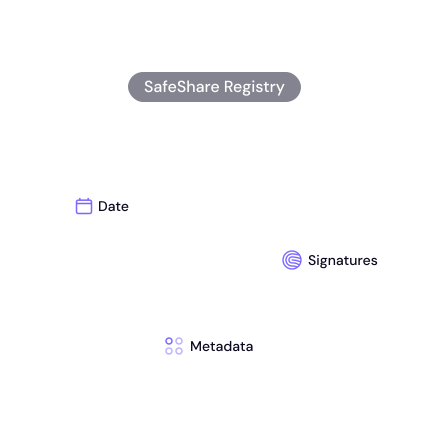
The registry only stores following information:

The Signature itself
When the Signature was created
What company or system that issued the Signature on behalf of a user or entity
Optionally, metadata on in what context an image can or cannot be used
The contents of the registry can be safely shared between partners such as tech platforms who wish to participate in ensuring that images are not misused.

With SafeShare we introduce an automated image protection paradigm

Together, the SafeShare engine and registry form the backbone of an automated image protection paradigm for the way individuals and businesses can protect their images and take action if permissions are violated.

Cut moderation costs

Scale enforcement without scaling headcount.

Automated check

Checks whether an image can be used or shared in a given context.

Get automated legal proof

Audit ready documentation packages.

Built-in compliance

Privacy-first tech aligned with regulation and is DSA compliant.
Contact us

Q & A

Here is a list with most asked questions, don’t hesitate to 
contact us for more information.
Why do we even alter the image?
Does the image get distorted by encoding a Signature?
Is the Signature the same as a Digital Watermark?
Can the signature be traced back to the image content?
Can a signature be forged?
What information, exactly, is embedded into the image?
Can personal information be disclosed?

Book a meeting

Let’s discuss how we can fight image abuse and build a safer digital world together.

Book meeting

For developers: 
AI-powered image protection API

Bring the value of our AI powered image protection technology into your applications by integrating with our Partner API.

Partner API

For developers: 
AI-powered image protection SDK

Infuse the value of our AI powered image protection technology into your applications by integration with our Mobile SDKs.

Mobile SDKs